.svg)

Oil and gas cybersecurity usually gets treated like a big-company problem. That's a mistake. If you run a small or mid-sized operator, you still have remote sites, vendor access, aging systems, compliance pressure, and very little patience for a slow security firm that charges too much and delivers a recycled report three weeks later.
You don't need more noise. You need a practical way to reduce risk, protect operations, support HSE, and prove you're taking security seriously without burning your budget on bloated consulting.
Understanding the Oil and Gas Threat Landscape
Oil and gas cybersecurity isn't the same as ordinary IT security. Protecting a finance app is one thing. Protecting a control environment that can affect pumps, valves, alarms, and process logic is something else entirely.
Think of IT like the front office. Email, payroll, file storage, customer systems. Think of OT like the control room. SCADA, HMIs, engineering workstations, and the devices that tell physical equipment what to do.
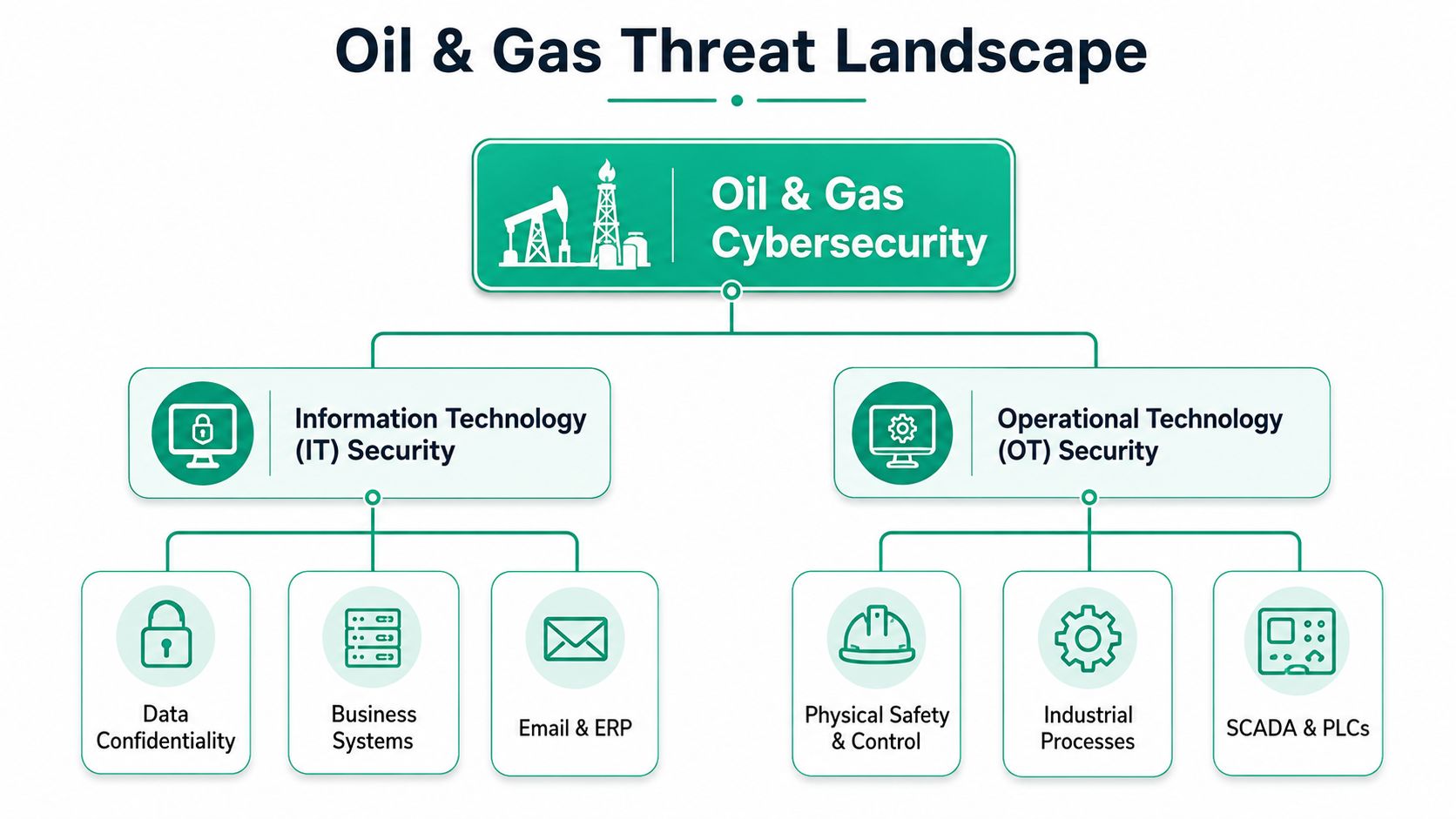
IT Security and OT Security Differ
If someone hits your IT network, you may lose data, email access, or financial records. That hurts. If someone reaches your OT environment, the impact can be far worse because they may interfere with physical operations.
That's why generic advice falls apart fast in this sector. A scanner that works fine on office systems can create problems in industrial environments if it's used carelessly. A compliance checklist built for SaaS companies won't tell you how to think about process safety, shutdown logic, or field communications.
Practical rule: If a system can influence a physical process, treat it differently from a normal business server.
For teams that need a plain-English foundation, Affordable Pentesting's OT security guide gives a useful overview of how operational technology changes the security conversation.
Why the Stakes Are So High
This sector is already under pressure. Over 50% of the top 391 oil and gas companies worldwide experienced at least one data breach within a single 30-day window in 2025, and 69% received a cybersecurity grade of D or F, according to the Journal of Petroleum Technology report on the Cybernews analysis.
That matters because weak security in oil and gas doesn't stay in the spreadsheet. It can affect uptime, safety, environmental exposure, and your ability to keep operations stable.
A lot of SMB teams still separate cyber from HSE in their heads. They shouldn't. In this industry, bad cyber hygiene can become an operations problem very quickly.
What Smaller Operators Miss
Smaller teams often assume attackers will go after the majors first. That logic is backwards. Attackers look for the easiest route in, and smaller operators often have fewer controls, less visibility, and more shared access with vendors and contractors.
Here's the simple version:
- IT compromise can expose data and business systems
- OT compromise can disrupt physical processes
- Shared connections between the two can turn a manageable issue into a plant or pipeline problem
If you only defend the office side, you're leaving the control side exposed. That's not oil and gas cybersecurity. That's wishful thinking.
How Attackers Target Energy Sector Systems
Most attacks don't start with movie-style hacking. They start with something boring that works. A weak remote access setup. A trusted vendor connection. An exposed system nobody remembered to lock down.
That's why oil and gas teams need to focus less on exotic threats and more on the attack paths criminals commonly use.
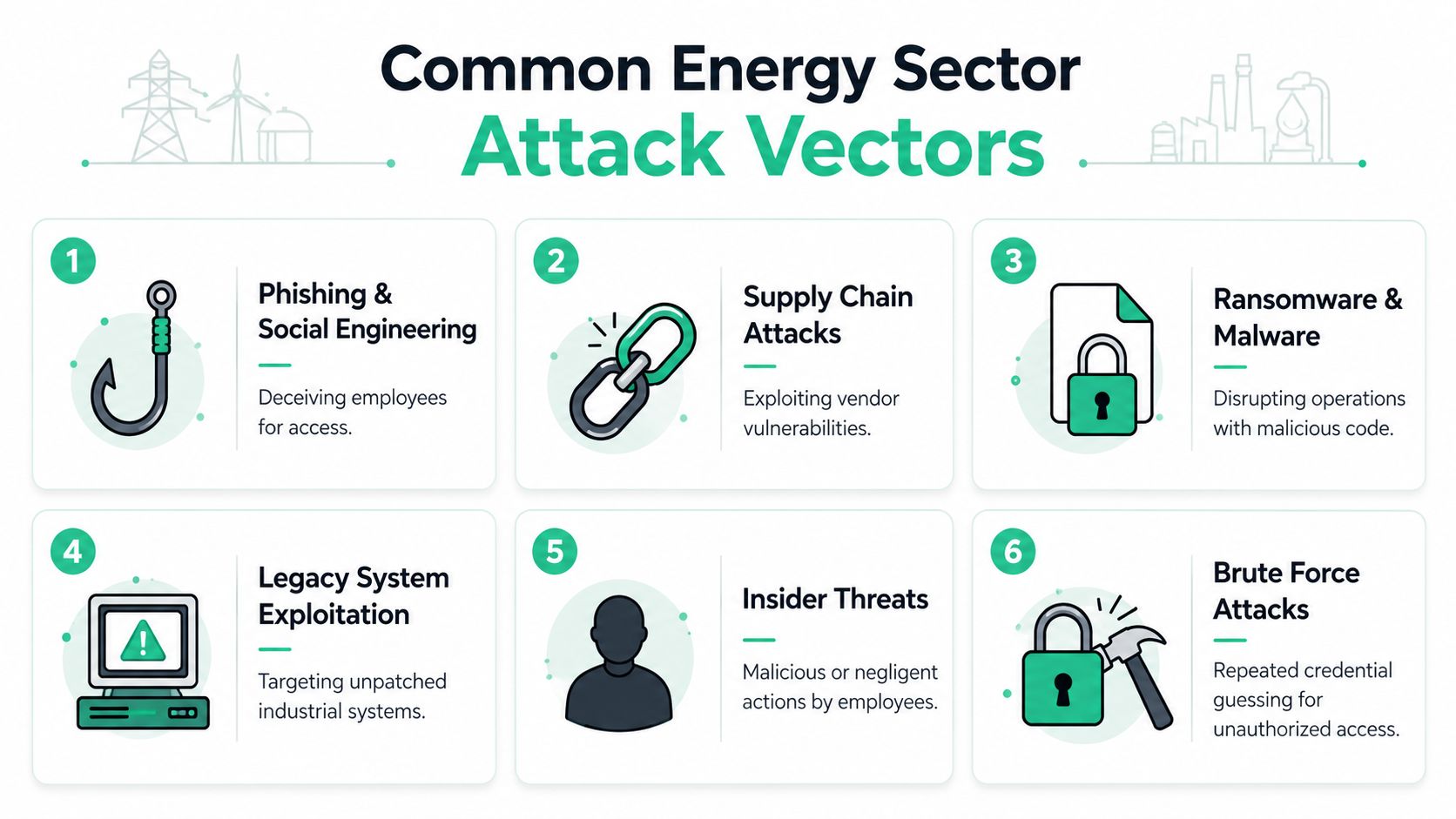
Ransomware Is an Operations Threat
Ransomware isn't just an IT nuisance in this sector. It can interrupt the reliable delivery of oil and gas, which makes it an operational issue, not just a data issue.
Ransomware attacks against oil and gas firms surged by 935% between April 2024 and April 2025, and the Canadian Centre for Cyber Security identifies ransomware as "almost certainly the primary cyber threat to the reliable supply of oil and gas to customers", as reported by Cybersecurity Dive covering the Zscaler findings.
That should settle the debate. If your team still treats ransomware as a back-office problem, you're underestimating the threat.
The Most Common Entry Points
Attackers usually don't need brilliance. They need access. In oil and gas, that often comes through remote paths into environments that were built for uptime first and security second.
Here are the weak spots I'd check first:
- Remote access tools: If staff, vendors, or contractors can reach critical systems from outside, that path needs hard review.
- Internet-facing systems: Anything exposed to the public internet deserves immediate attention, especially portals, gateways, and admin interfaces.
- Vendor relationships: A trusted third party can become your problem fast if their security is sloppy.
- Legacy systems: Old industrial equipment often stays online because operations can't pause for upgrades.
Attackers don't care whether a connection exists for convenience, maintenance, or emergency support. If it works for your team, it can work for them.
Why Traditional Detection Fails
A lot of firms still rely on tools built for ordinary IT. Those tools can miss suspicious behavior inside industrial environments because OT traffic and ICS protocols don't look like normal office traffic.
That's one reason pen testing, pentests, and manual penetration testing matter so much here. A good tester doesn't just run a scanner and export a report. They trace real attack paths, validate risk, and show you where an attacker could move from a weak edge system toward more sensitive operational assets.
If your current provider gives you a giant PDF full of low-value scanner output, that's not a real pen test. That's paperwork.
Navigating Oil and Gas Compliance Requirements
Compliance in oil and gas is messy because the rules don't land evenly. Bigger operators may have clearer mandates and larger budgets. Smaller and midstream operators often get the pressure without the support.
That leaves many teams stuck in the same place. They know they need better controls, but they don't know what regulators, auditors, customers, and insurers will accept as proof.
The Midstream Regulatory Gap
Many small-to-midstream operators fall below the critical designation threshold of the 2021 DHS and TSA security directive. That creates a real compliance problem because they face the same threats as larger firms but often lack the same funding and clear implementation path, as explained in this analysis of digital security for critical sectors from Kogifi and in the broader industry discussion around smaller operators.
The hard truth is simple. You may not be formally classified the same way as a major operator, but attackers won't care, and business partners won't lower their expectations just because your budget is smaller.
Auditors Want Evidence, Not Intent
Saying you take security seriously doesn't help much. You need evidence. That usually means documented assessments, clear remediation steps, ownership, and a record that shows you're not guessing.
A practical compliance package usually includes:
- Current findings: A recent penetration test or pen test report that shows what was reviewed and what was found
- Prioritization: Clear risk ranking so your team can prove it fixed the most important issues first
- Remediation records: Tickets, change logs, or formal notes showing action
- Repeatability: A schedule for future penetration testing so your process doesn't look one-and-done
Why This Matters for SMB Budgets
A lot of smaller operators overspend because they assume compliance requires a giant consulting engagement. It usually doesn't. What it requires is credible evidence and a sane process.
That's where an affordable manual pentest earns its keep. It gives your team something concrete to act on, something an auditor can review, and something leadership can understand without sitting through a pile of jargon.
If your security work can't be explained in a few plain sentences, it's probably too complicated for a lean operator to sustain.
Why Fast and Affordable Penetration Testing Wins
Most traditional penetration testing firms still sell like it's ten years ago. Long scoping calls. Bloated statements of work. Weeks of waiting. Then a report arrives stuffed with generic findings that your team could've pulled from a scanner.
That model is broken for oil and gas SMBs.

What a Good Pentest Actually Does
A real pentest is controlled attack simulation. A skilled tester looks for the paths an attacker would use, proves what's exploitable, and gives you a report you can act on.
That's why manual work matters. Automated tools are useful for coverage, but they often miss business logic flaws, chained weaknesses, access control mistakes, and the context that turns a minor issue into a major one.
For oil and gas teams, penetration testing is especially useful when you need to review:
- Customer and vendor portals
- Operational dashboards
- Internet-facing infrastructure
- Remote access exposure
- Weak handoffs between IT and OT
Speed Matters More Than Firms Admit
If you wait weeks for findings, you lose momentum. Compliance deadlines don't pause. Remediation doesn't start. Leadership forgets why the test mattered in the first place.
That's why fast reporting wins. A standard web application penetration test for moderate-complexity apps, like operational dashboards, typically costs between $5,000 and $15,000, and this pricing enables startups and SMBs to get affordable manual pentests with reports delivered within a week, according to this breakdown of web application penetration testing pricing.
That price range is workable for many smaller operators. More important, the delivery timeline is workable. You can test, review, fix, and move forward without dragging the project across a whole quarter.
Certification Still Matters
Cheap doesn't mean careless. If you're paying for a pen test, ask who's doing the work and what credentials they hold.
Look for OSCP, CEH, and CREST. Those don't guarantee quality on their own, but they're a useful baseline. They show the provider takes offensive security seriously and doesn't treat penetration testing like a checkbox service run by junior staff with automated tooling.
What to ask first: Who performs the test, how much of the work is manual, and when do we get the report?
If you want a better sense of what application-focused reviews should uncover, these essential web application security insights are a helpful reference point.
Why This Helps HSE Too
A good penetration test doesn't just protect data. It helps reduce the chance that weak remote access, a fragile dashboard, or a poorly secured edge service becomes the bridge into something more sensitive.
That matters for HSE because operational interruptions don't happen in a vacuum. If your systems that support process monitoring, alarming, or remote coordination are compromised, safety and reliability can suffer fast.
That's why I push affordable manual pentests so hard. Not because they sound good in procurement paperwork. Because they're one of the fastest ways to turn vague cyber risk into a fix list your team can use.
Designing a Practical Risk-Based Security Architecture
A pentest shows you where the holes are. Architecture decides whether those holes become a real incident.
You don't need an enterprise redesign to get better. You need a few smart controls that reduce exposure without making operations miserable.
Start With Separation
The first move is segmentation. In plain English, that means putting barriers between business systems and operational systems so one problem doesn't spread everywhere.
Like bulkheads in a ship, if one section takes on water, the whole vessel doesn't sink.
A practical starting point looks like this:
- Separate office and operational networks: Don't let ordinary user traffic sit too close to critical control systems.
- Control remote pathways: Vendor and contractor access should pass through approved choke points, not wander freely.
- Limit admin privileges: Not everyone needs broad access, and almost nobody needs it all the time.
Build Visibility Before Fancy Controls
A surprising number of teams still don't have a reliable list of what's connected. That's a problem because you can't protect what you can't see.
Start with a basic asset inventory, then map who can access what. If your team is experimenting with automation or AI-driven workflows in engineering, support, or code generation, treat those tools carefully too. This guide for secure AI agent code from AY Automate is worth reading because new convenience tools can inadvertently introduce new pathways and data exposure.
Good architecture is boring on purpose. It limits blast radius, reduces surprises, and makes bad days smaller.
Use Risk to Drive Spending
Don't buy controls because a vendor scared you. Buy them because they reduce a meaningful risk in your environment.
A simple way to think about it is:
PriorityQuestion to askHighestCan this system affect operations or safety if compromised?HighIs it internet-facing or remotely accessible?MediumDoes it connect business users, vendors, or field assets?LowerIs it isolated, limited, and easy to recover?
If you need a straightforward way to score these decisions, this simple guide to risk assessment can help your team keep things practical.
Developing a Realistic Incident Response Roadmap
Most oil and gas SMBs don't need a giant security operations center. They need a plan people can follow when stress is high and time is short.
That plan should fit the reality of your environment. Remote sites. Contractors. Shared responsibilities. A mix of office systems and operational systems. Maybe one internal security lead wearing five hats.
Build the Plan Before You Need It
If your incident response plan starts with people asking who owns the issue, you already lost time. The best roadmap is simple, written down, and tested enough that nobody has to improvise the basics.
Your first version should answer four plain questions:
- Who declares an incident
- Who gets called first
- Which systems matter most
- Who can approve containment actions
Keep it short. Nobody reads a fifty-page response plan during a live incident.
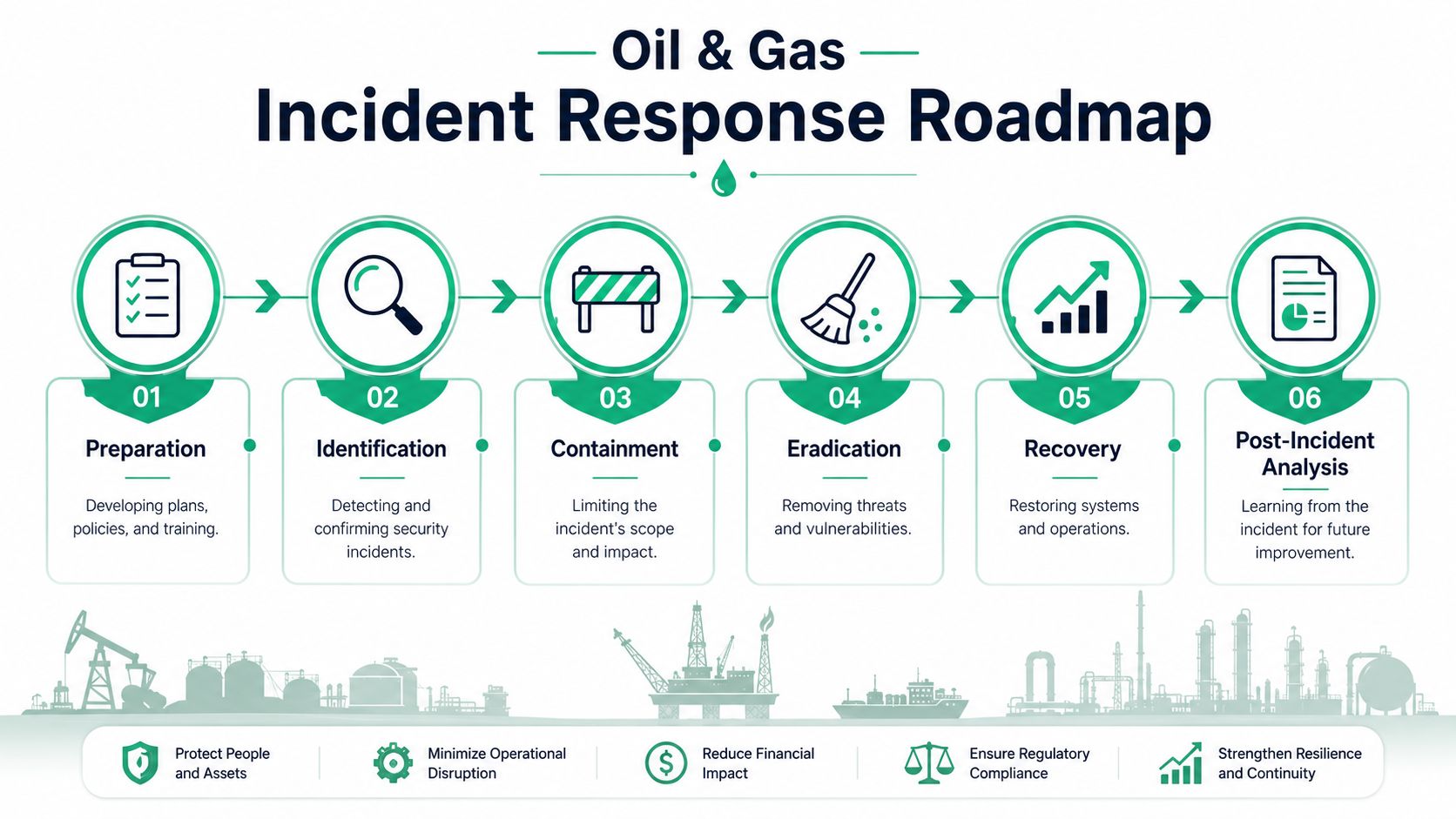
Use a Six-Step Response Flow
The standard flow still works if you keep it grounded in operations.
- Preparation
Build contact lists, escalation paths, and access to key logs and backups. Make sure IT, operations, compliance, and leadership know their role. - Identification
Confirm what happened. Don't confuse a noisy alert with a true incident, but don't wait forever for perfect certainty either. - Containment
Stop the spread. That might mean disabling an exposed account, isolating a server, or restricting a remote connection. - Eradication
Remove the cause. Reset credentials, close the access path, remove malicious tools, and fix the weakness that allowed entry. - Recovery
Restore systems carefully. Validate that business and operational functions are stable before you declare victory. - Post-incident analysis
Document what happened, what failed, and what needs to change. If you skip this part, you'll repeat the same mistakes.
Keep IT and OT Decisions Separate
One of the biggest mistakes I see is treating every incident like a standard office breach. That can create dangerous decisions in industrial environments.
For example, “just shut it down” may sound decisive in IT. In OT, that decision may affect safety, continuity, or field operations. Your roadmap should identify which systems can be isolated quickly and which ones require operations input before any action is taken.
In oil and gas cybersecurity, a fast wrong move can be as damaging as a slow response.
That's why your response contacts should include operations and HSE voices, not just IT.
Make the Plan Usable for Small Teams
You don't need perfection. You need a version that works with your staffing and budget. For most SMBs, that means using outside help selectively and preparing internal staff to handle the first critical steps.
Focus on these basics first:
- One decision owner: Somebody must have authority to trigger the plan
- One contact path: Use a defined method for urgent communication
- One system priority list: Know what must come back first
- One evidence process: Save logs, screenshots, tickets, and timeline notes early
Then run a simple tabletop exercise. Walk through a ransomware event, a compromised vendor account, or a suspicious remote access alert. Don't make it fancy. The point is to expose confusion before a real incident does.
Tie Response Back to Testing and Architecture
Incident response only works if it connects to the rest of your security work. Your penetration testing should help shape your response plan by showing where attackers are likely to get in. Your architecture should support containment by limiting lateral movement. Your compliance documentation should prove that these activities are ongoing, not occasional.
That's the practical model for oil and gas SMBs. Understand the environment. Test what matters. Segment what you can. Prepare for the day something gets through anyway.
If that sounds less glamorous than enterprise cybersecurity marketing, good. Glamour doesn't keep a site running.
If your team needs a pen test, pentest, or full penetration testing report without the usual bloated timeline and overpriced scope, Affordable Pentesting is built for exactly that. They provide affordable manual pentests for SMBs and startups, use certified ethical hackers with OSCP, CEH, and CREST backgrounds, and focus on getting you useful findings and audit-ready reporting fast. If you want a simpler path to oil and gas cybersecurity, use their contact form and start with a scope that matches your real risk.