.svg)
You bought private cloud for control. Good. But a lot of teams stop there and assume the environment is now secure by default. That's where trouble starts.
The usual story is ugly and predictable. The company pays for dedicated infrastructure, the audit date gets close, someone finally runs a thorough review, and then the mess appears. Weak access rules. Old software. Overexposed admin paths. Logging that exists on paper but doesn't help anyone in practice.
Security in private cloud isn't about buying a more exclusive environment and hoping for the best. It's about proving your controls work, fixing what doesn't, and doing it before an attacker or auditor finds the gap for you.
Why Your Private Cloud Is Not Automatically Secure
A private cloud gives you isolation. It does not give you discipline.
That distinction matters. Wiz explains private cloud security as reducing exposure through isolation because the infrastructure is dedicated to one organization, which lowers multi-tenancy risk and gives security teams tighter control over identity, access, and encryption policies. That's a real advantage. It just isn't a free pass.

Isolation helps but mistakes still win
Most private cloud failures come from ordinary problems, not movie-plot hacking. A rushed firewall change opens the wrong path. An old management interface stays exposed. An admin account keeps more access than it needs. Someone spins up a workload outside the approved process and no one notices.
Private infrastructure narrows some risks, but it also puts more responsibility on your team. If you own the environment, you own the misconfigurations too.
A few common failure points show up again and again:
- Access gets too broad because teams hand out admin rights to move faster
- Patching slips because private cloud platforms often rely on internal maintenance windows
- Logs stay unread because collecting data is easier than reviewing it
- Shadow IT spreads when business teams bypass the approved stack
- APIs get ignored even though they often expose the control plane attackers want
Practical rule: If your team hasn't tested the environment like an attacker would, you don't know how secure it is.
Validation beats assumptions every time
This is why smart teams don't rely on architecture diagrams and policy documents alone. They validate controls with actual testing. Not six weeks of bloated consulting theater. Real testing that checks whether segmentation works, whether auth controls hold up, and whether exposed paths can be abused.
If you need a plain-English breakdown of where these issues tend to hide, this guide will help you find cloud flaws fast.
The hard truth is simple. A private cloud can absolutely be the right choice for sensitive workloads. But if no one is actively checking access, encryption, workload separation, and monitoring, you're paying for control without getting the security benefit.
Private vs Public Cloud Security Explained
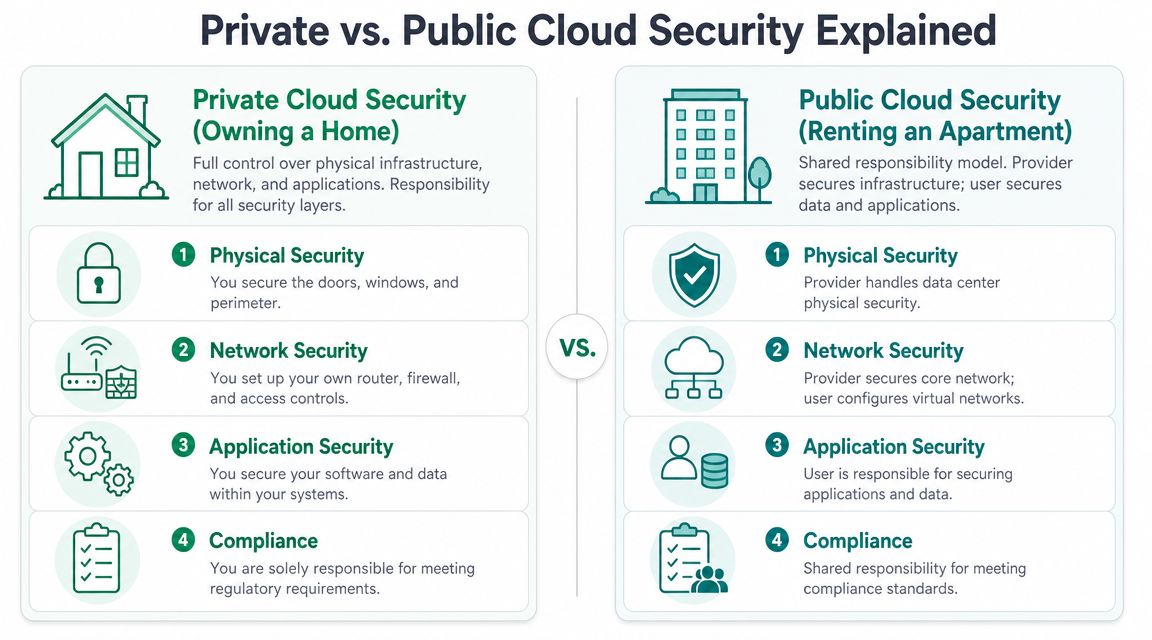
The easiest way to understand this is simple. Private cloud is like owning a house. Public cloud is like renting an apartment.
Both can be secure. But the job list is different.
Owning the house
In a private cloud, you control the whole property. You decide how the doors lock, where cameras go, who gets keys, and which rooms stay off limits. That's powerful. It's also work.
When your infrastructure is dedicated to your organization, you get tighter control over identity, access, and encryption policy. You also reduce multi-tenancy risk because you aren't sharing the same underlying environment with other tenants. That's a big reason private cloud remains a strong fit for regulated and sensitive workloads.
Renting the apartment
In a public cloud, the provider handles a lot of the building-level protection. They secure the facility and maintain core platform components. But you still need to secure what you put inside your unit. Your apps, your data, your permissions, your configurations. Those are still your problem.
A lot of teams get this wrong in both directions. They assume public cloud means the provider handles everything, or they assume private cloud means they've escaped shared responsibility entirely. Neither is true.
| Model | Main advantage | Main burden |
|---|---|---|
| Private cloud | Dedicated infrastructure and stronger control boundaries | You manage more of the security stack yourself |
| Public cloud | Provider handles more infrastructure operations | You must understand the shared responsibility model clearly |
What changes in practice
In a private cloud, security teams need to think more like owners than tenants. That changes the day-to-day work.
- Physical safeguards matter more because your organization is closer to the hardware and facility decisions
- Network design matters more because segmentation mistakes are yours to create and fix
- Identity design matters more because broad internal trust becomes dangerous fast
- Compliance evidence matters more because customers and auditors want proof, not assumptions
You chose private cloud to get more control. Use it. Teams that copy lazy public cloud habits into private cloud usually end up with slower systems and the same security gaps.
Private cloud can be safer for the right workloads. But only if your team acts like the owner of the whole security model, not just the consumer of a platform.
Essential Private Cloud Security Controls
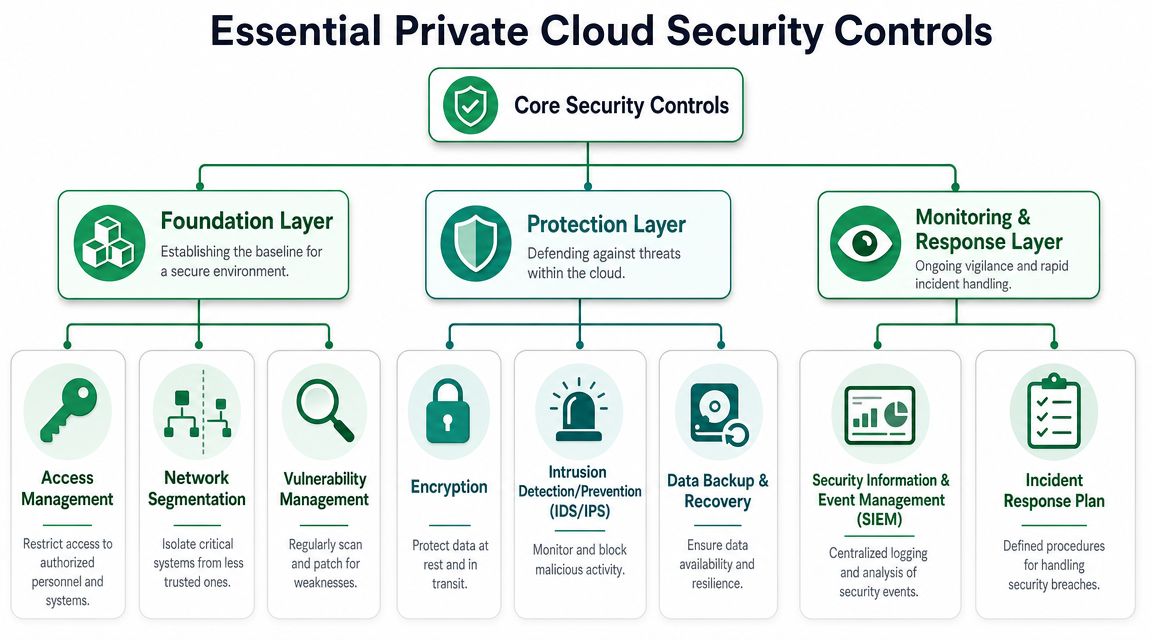
Private cloud security doesn't need to sound complicated. Start with the controls that lower risk, then make sure they're enforced everywhere instead of half-configured in one corner of the environment.
Lock down identity and access
If too many people have broad access, the rest of your controls won't save you. Access control and identity management sit at the center of private cloud security for a reason. Strong authentication, tight role assignments, and regular access reviews stop a small mistake from turning into a major incident.
Two-factor authentication should be standard for administrative access. So should strict separation between day-to-day user accounts and privileged accounts.
Segment the environment properly
Think of network segmentation as building walls inside the house. Your backup systems shouldn't sit wide open to everything else. Management interfaces shouldn't live on the same trust level as ordinary workloads. Sensitive systems need their own boundaries.
A flat network is convenient until someone gets in. Then it's a gift to the attacker.
Encrypt data where it lives and moves
Encryption at rest protects stored data. Encryption in transit protects data while systems send it back and forth. Both matter.
If sensitive data moves between workloads, backups, vendors, or connected tools, you need clear policy around how it's protected and who can decrypt it. Key handling matters just as much as encryption itself.
Harden hosts, workloads, and images
A private cloud isn't secure because the hypervisor exists. Every host, virtual machine, container, and image still needs attention.
Use secure baselines. Remove what isn't needed. Patch what is needed. Prefer immutable infrastructure where possible so teams replace workloads with known-good versions instead of making ad hoc changes on live systems.
Monitor like you mean it
Continuous monitoring and detailed logging aren't optional. HPE's guidance, as summarized in the Wiz resource cited earlier, stresses strong authentication, patching, SIEM-based monitoring, and workload segregation to support confidentiality, integrity, and availability.
That means your logs need to answer real questions fast:
- Who accessed what
- Which admin action changed the environment
- What system started behaving oddly
- Whether a control failed unnoticed
If your team is still trying to move toward implementing zero trust security, private cloud is exactly where that effort should get serious.
Good controls don't impress anyone if they're inconsistent. The secure standard has to be the default, not the special project.
Keep API and change risk in scope
Many teams often overlook a critical aspect. They protect servers and forget the control plane. API security policies matter in private cloud too. OAuth 2.0, JWT handling, rate limiting, and gateway-level anomaly detection all deserve attention when your environment relies on automation and service-to-service access.
The short version is simple:
- Identity controls decide who gets in
- Segmentation limits movement
- Encryption protects the data
- Hardening reduces exposed weaknesses
- Monitoring tells you what's happening
- API controls keep automation from becoming the weak point
Meeting Compliance in Your Private Cloud
Organizations don't invest in private cloud security because they love writing policies. They do it because customers, auditors, and regulators keep asking hard questions.
That's fair. SentinelOne's cloud security statistics report that roughly 45% of all data breaches occur in cloud environments and more than 80% of companies experienced at least one cloud security breach in the past year. When the breach risk is that visible, nobody accepts vague promises anymore.
Controls are what auditors buy into
Frameworks like SOC 2, HIPAA, PCI DSS, and ISO 27001 don't care about your intentions. They care about repeatable controls and evidence that people follow them.
That changes how you should look at your private cloud. Network segmentation isn't just a smart architecture choice. It's the sort of control that helps you show separation of sensitive systems. Strong IAM isn't just an admin preference. It's how you prove only the right people can reach regulated data. Encryption isn't just best practice. It's part of showing that stolen or intercepted data won't be useful.
A simple way to think about it:
| Control area | Why compliance teams care |
|---|---|
| Access control | Shows who can reach systems and sensitive data |
| Logging and monitoring | Creates evidence for review, detection, and investigations |
| Segmentation | Limits exposure between trusted and less trusted systems |
| Encryption | Protects sensitive information at rest and in transit |
| Patching and change control | Shows systems are maintained and changes are governed |
Private cloud can help or hurt
Private cloud often makes compliance easier because you have tighter control over the environment. That's the upside. The downside is that you can't hide behind a provider when evidence is missing.
I've seen teams spend heavily on infrastructure, then cheap out on the validation and documentation that audits depend on. That's backward. If your controls aren't visible, enforced, and testable, the architecture won't save you.
Auditors don't fail companies for lacking fancy tooling. They fail them because the company can't prove who had access, what changed, and whether anyone was watching.
Treat compliance as an operating discipline
The cleanest path is boring on purpose. Define the control. Implement it consistently. Log it. Review it. Test it. Keep evidence ready.
That's what turns private cloud from a technical project into a business asset. It doesn't just host sensitive workloads. It gives you a cleaner path to customer trust, contract approvals, and audit readiness.
Smart Operational Security Practices
A secure private cloud can still fall apart through bad habits. Most failures happen in operations, not in strategy decks.
The shift now is toward data-centric security, not just infrastructure-centric security. Sentra's private cloud security guidance highlights the need for live inventories of sensitive data, automated classification, and visibility into who and what can access it because risks now include uncontrolled data sprawl across cloud, SaaS, and on-prem systems. That's the operational reality teams need to manage.
Run a discipline you can repeat
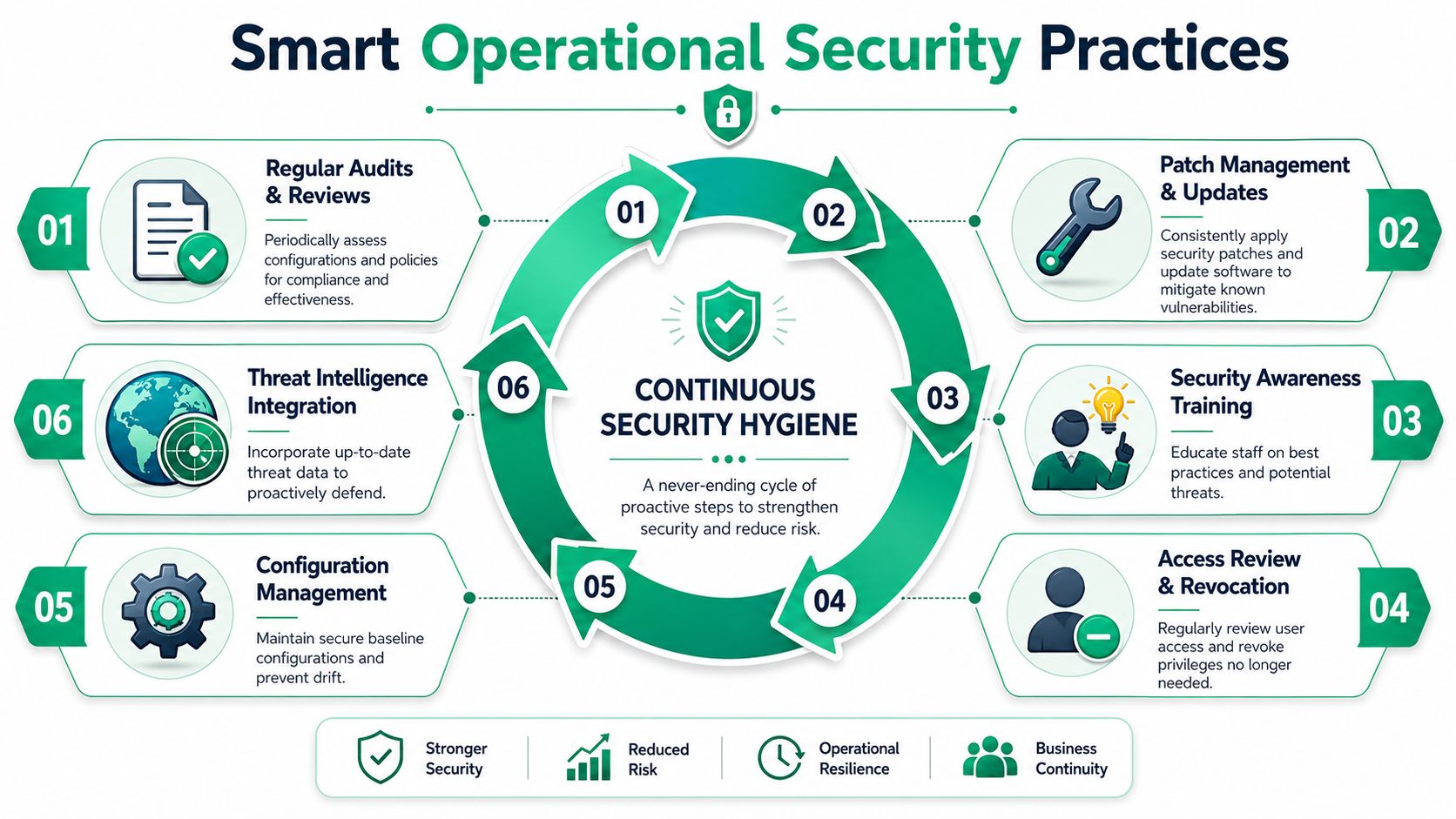
You don't need a giant playbook nobody follows. You need a routine your team can maintain.
Patch on schedule
Known weaknesses should not sit around waiting for the next maintenance debate. If a system is critical, patching needs urgency and ownership.Control changes tightly
Most risky exposure comes from normal admin activity. Review major network, identity, and application changes before they hit production.Review access often
Staff change roles. Vendors come and go. Old accounts linger. If you don't revoke access aggressively, your environment gets weaker every month.Watch logs for real signals
Logging without review is storage, not security. Your team should know what events trigger action and who responds.
Focus on data movement, not just system status
A lot of security teams still ask, "Are the servers locked down?" That's fine, but it's incomplete. The better question is, "Where is sensitive data moving, who can reach it, and which machine identities can touch it?"
That means operational security in private cloud should include:
- Data inventory so you know what matters most
- Classification so sensitive material isn't treated like ordinary data
- Access visibility across users, apps, services, and backups
- Recovery readiness so ransomware or accidental deletion doesn't end the story
The healthiest private cloud environments aren't the ones with the most tools. They're the ones where admins can explain what changed last week, who approved it, and how they'd contain a problem today.
Prepare for bad days before they happen
Incident response needs to be usable under pressure. Keep the plan simple. Know who makes decisions. Know how to isolate systems. Know how to preserve logs and records for investigation.
If your plan depends on three unavailable executives and a consultant who replies next Tuesday, it isn't a plan.
Validating Security with Penetration Testing
Controls on paper are cheap. Validation is what counts.
A pentest, pen test, or penetration test is simple to explain. You hire certified ethical hackers to think like attackers and look for the weaknesses your internal team missed. Good penetration testing shows whether segmentation works, whether exposed services can be abused, whether weak auth can be chained into bigger access, and whether your private cloud is resilient under realistic pressure.
Why traditional firms waste your time
A lot of companies are fed up for good reason. The usual process is slow, expensive, and padded with ceremony. You wait weeks for kickoff. Then more weeks for testing. Then you get a report full of filler and barely any findings, which is somehow presented as good news.
It isn't good news if the test was shallow.
A proper pen test should be fast enough to fit the pace of the business and deep enough to matter for engineering and compliance. If your team is shipping updates, changing network policy, integrating vendor services, or expanding remote admin access, you can't wait forever for results that should have landed this week.
What useful penetration testing looks like
Useful testing is practical. The testers understand cloud paths, identity abuse, exposed management surfaces, insecure APIs, and the compliance pressure behind all of it. They also write reports people can use, not academic essays nobody reads.
The certifications matter too. OSCP, CEH, and CREST signal that the pentesters have been trained and assessed against recognized standards. That doesn't guarantee quality by itself, but it's a much better starting point than flashy sales decks.
For teams that also manage deployment pipelines or device update flows, this article on best practices for OTA security is worth reading because software delivery paths often become part of the actual attack surface.
A pentest should answer one question clearly. If someone targeted this environment today, where would they get in and how far could they go?
Use testing to prove readiness
Fast, affordable testing changes the game. You don't need a bloated consulting engagement just to validate your private cloud. You need a real assessment, real findings, and an audit-ready report quickly enough to act on it.
If you're comparing options, this guide to cloud pentesting for businesses gives a practical view of what to expect from a cloud-focused engagement.
Run the test. Fix the findings. Retest what matters. That's how you turn private cloud security from a belief into evidence.
Get Your Private Cloud Secured This Week
Private cloud gives you a better control model. It does not remove the need for hard security work.
The winning pattern is straightforward. Build the right controls. Operate them with discipline. Validate them with a real penetration test. Do that consistently and your private cloud becomes a business advantage instead of an expensive guess.
Keep the model simple
Security in private cloud usually breaks down when teams overcomplicate the tooling and underinvest in the basics. Tight access. Clean segmentation. Strong encryption. Meaningful logs. Controlled changes. Real validation.
That's not glamorous. It works.
Stop paying for slow security theater
A lot of companies are still stuck with overpriced firms that move at a consultant's pace instead of a business pace. They burn weeks, drain budget, and deliver reports that don't help engineering or compliance very much.
You don't need that model. You need testing that is affordable, fast, and clear enough to drive action immediately.
What to do next
If your private cloud supports sensitive workloads, customer data, regulated systems, or audit scope, don't wait for the next review cycle to expose the gaps. Get a real pentest. Get a useful penetration test report. Get answers while there's still time to fix issues calmly instead of under pressure.
The strongest teams don't assume they're secure. They check.
If you need an affordable way to validate your private cloud this week, Affordable Pentesting offers manual pentests, pen tests, and penetration testing for cloud environments with certified pentesters holding OSCP, CEH, and CREST credentials. The process is built for teams that want real findings, audit-ready reporting, and fast turnaround without the bloated pricing and delays common with traditional firms. Use the contact form to get a quote and schedule your test.