.svg)
Identity and Access Management Testing Guide
Your audit date is close. Your IAM setup has grown fast. Someone added Okta, someone else wired up Google Workspace, your developers have service accounts everywhere, and offboarding still depends on a checklist in a ticket.
Then the quotes come in. One firm wants enterprise money. Another wants weeks before they even start. A cheap scanner service promises a fast pen test, but it won't tell you whether a fired employee can still get into your payroll app or whether a vendor account keeps access after a contract ends.
That gap is where identity and access management testing matters. This isn't theory. It's a practical penetration test that checks whether the right people get access, the wrong people don't, and your audit evidence holds up when someone asks hard questions.
Your Simple Guide to IAM Pentesting
Why teams get stuck
Most startups and SMBs don't have a clean IAM environment. They have a working one. That's normal. Access control usually grows around the business, not the other way around.
The trouble starts when compliance shows up. SOC 2, ISO 27001, HIPAA, and PCI DSS all push you toward the same question. Can you prove your access controls are effective?
Traditional penetration testing firms often make this harder than it needs to be. A standard manual pentest for SOC 2 and ISO 27001 compliance typically takes 3 to 6 weeks according to Casco's breakdown of pentesting levels. That timeline is rough if your board wants answers now.
What a practical IAM pen test looks like
A good IAM pentest doesn't try to test everything in your company at once. It focuses on the systems that control access and the paths attackers abuse.
That usually means checking things like:
- Login controls like MFA, SSO, password policy, and account lockout
- Authorization rules so users can't view data outside their role
- Joiner mover leaver workflows so access is added and removed correctly
- Privileged access for admins, contractors, and service accounts
- Audit evidence that maps test results to what an assessor expects
Practical rule: If your pentester can't explain the scope in plain English, the scope is too broad or the tester doesn't understand IAM.
You don't need a bloated engagement. You need a penetration test that produces clear findings, simple fixes, and an audit-ready report without dragging on for a month.
What to ask for first
Start with the business problem, not the tool list. Tell the provider what apps matter, which users carry privilege, and what audit you're facing.
Ask these questions early:
- Can you test real user flows like onboarding, role changes, and offboarding?
- Will this be manual penetration testing or mostly automated scanning?
- Do your testers hold OSCP, CEH, or CREST certifications?
- Can you deliver findings fast enough for an active compliance timeline?
- Will the report explain business impact instead of dumping raw technical notes?
A strong IAM pen testing engagement should feel focused, fast, and useful. If it feels vague, expensive, and slow, you're probably paying for overhead.
Why Your Business Needs IAM Penetration Testing
Attackers don't need to break in if they can sign in. That's the whole problem.
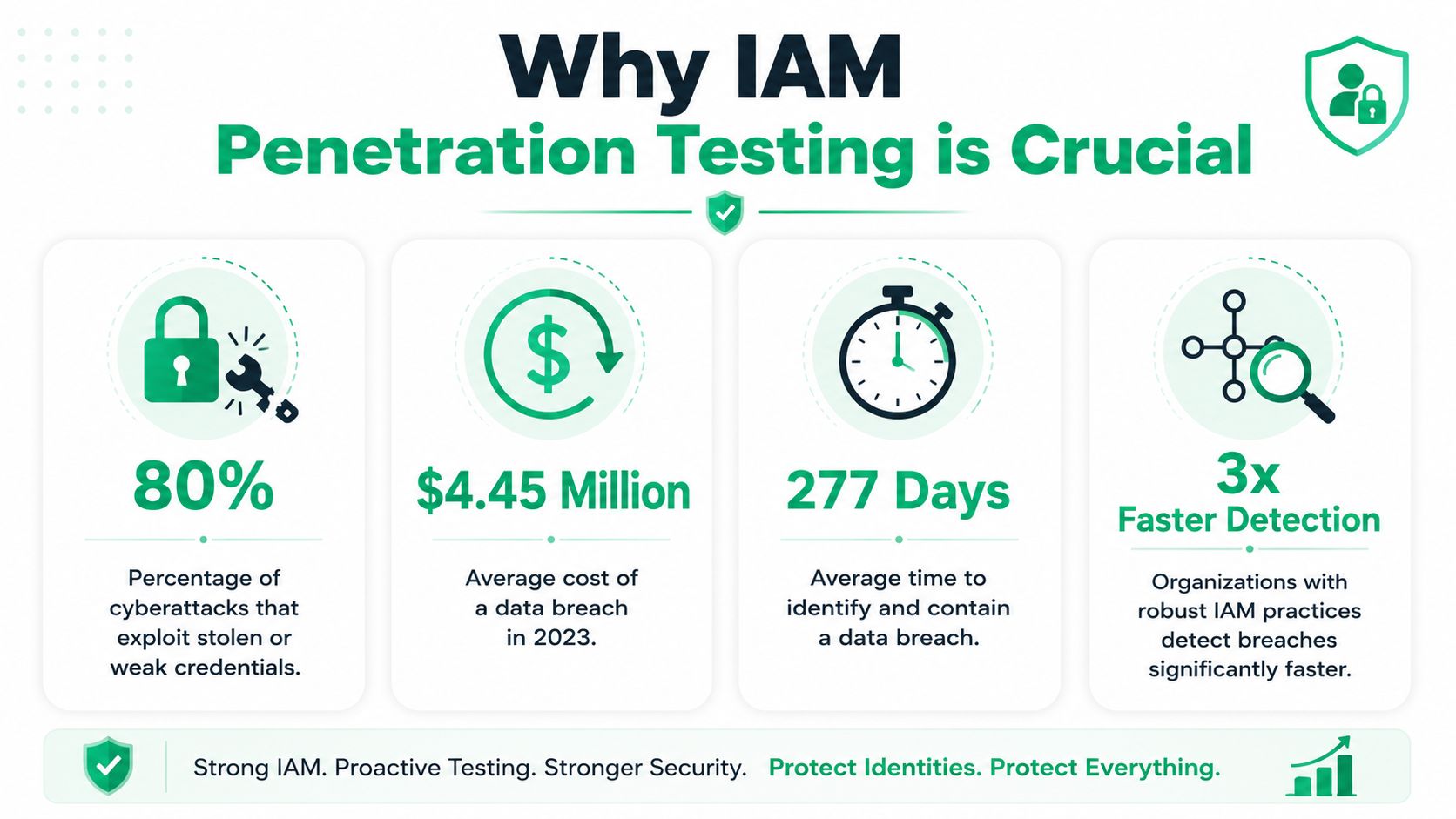
80% of all cyberattacks utilize identity-based attack methods, such as phishing, social engineering, and account takeover, which is why IAM testing belongs near the top of your security list, not buried under generic infrastructure checks, as noted by Tenfold Security's IAM statistics.
Compliance is not the main reason
Yes, auditors care about IAM. They should. But the primary reason to run an IAM penetration test is that identity failures turn into business failures fast.
A weak login flow can expose customer data. A bad role mapping can let a support user reach finance records. A stale admin account can survive after an employee leaves. None of those are abstract security issues. They create breach risk, downtime, and ugly conversations with customers and regulators.
What attackers look for
They look for the simple path first. Reused credentials. Weak MFA handling. Overpowered accounts. Forgotten users. Misconfigured SSO trust. Service accounts nobody owns.
That's why a real pen test is better than a checkbox review. A proper tester acts like an attacker and asks blunt questions:
- Can I log in with a low-privilege user and move sideways?
- Can I bypass MFA through a weak recovery flow?
- Can I keep access after offboarding should have removed it?
- Can I abuse a service account that never rotates credentials?
If your IAM controls haven't been tested under attack conditions, you're trusting process diagrams more than evidence.
Identity and access management testing gives you evidence. It shows whether your controls work in the mess of real life, not just on a policy slide.
Defining Your IAM Testing Scope Quickly
A bad scope burns time and money. A clean scope gets you useful answers fast.
Start with what grants access, not every system you own. Your tester doesn't need a full inventory of your company. They need the applications, identity providers, privileged groups, and workflows that decide who gets in.

Scope the control plane first
Think in layers. Put your identity provider at the center, then work outward.
A practical scope usually includes:
- Identity provider such as Okta, Microsoft Entra ID, Google Workspace, or another SSO platform
- Critical apps like your CRM, HR system, cloud console, code repo, ticketing platform, and finance tools
- Privileged roles including global admins, billing admins, security admins, and break-glass accounts
- Lifecycle processes for onboarding, promotions, department changes, and offboarding
Don't forget machine identities. API keys, service accounts, and automation users often have broad access and weak ownership.
Don't ignore vendor access
Organizations frequently forget third-party users until an audit asks for proof. That's a mistake. Third-party access now constitutes 30% of breaches, doubling from 15% last year, yet standard testing often skips time-boxed access and MFA enforcement for external vendors, according to Centric Consulting's IAM risk assessment overview.
That means your scope should include vendor and contractor accounts if they touch sensitive systems.
Use this quick checklist before your pen testing kickoff:
- List external users who log into your environment directly
- Mark time-boxed access that should expire automatically
- Identify MFA gaps for vendors, consultants, and subcontractors
- Note approval paths for granting and extending third-party access
Scope should follow risk. If a vendor can touch production, payroll, or patient data, that account belongs in the test.
A narrower, smarter penetration test beats a giant vague one every time. Your report gets sharper, your turnaround gets faster, and your budget goes further.
Key IAM Test Cases You Cannot Ignore
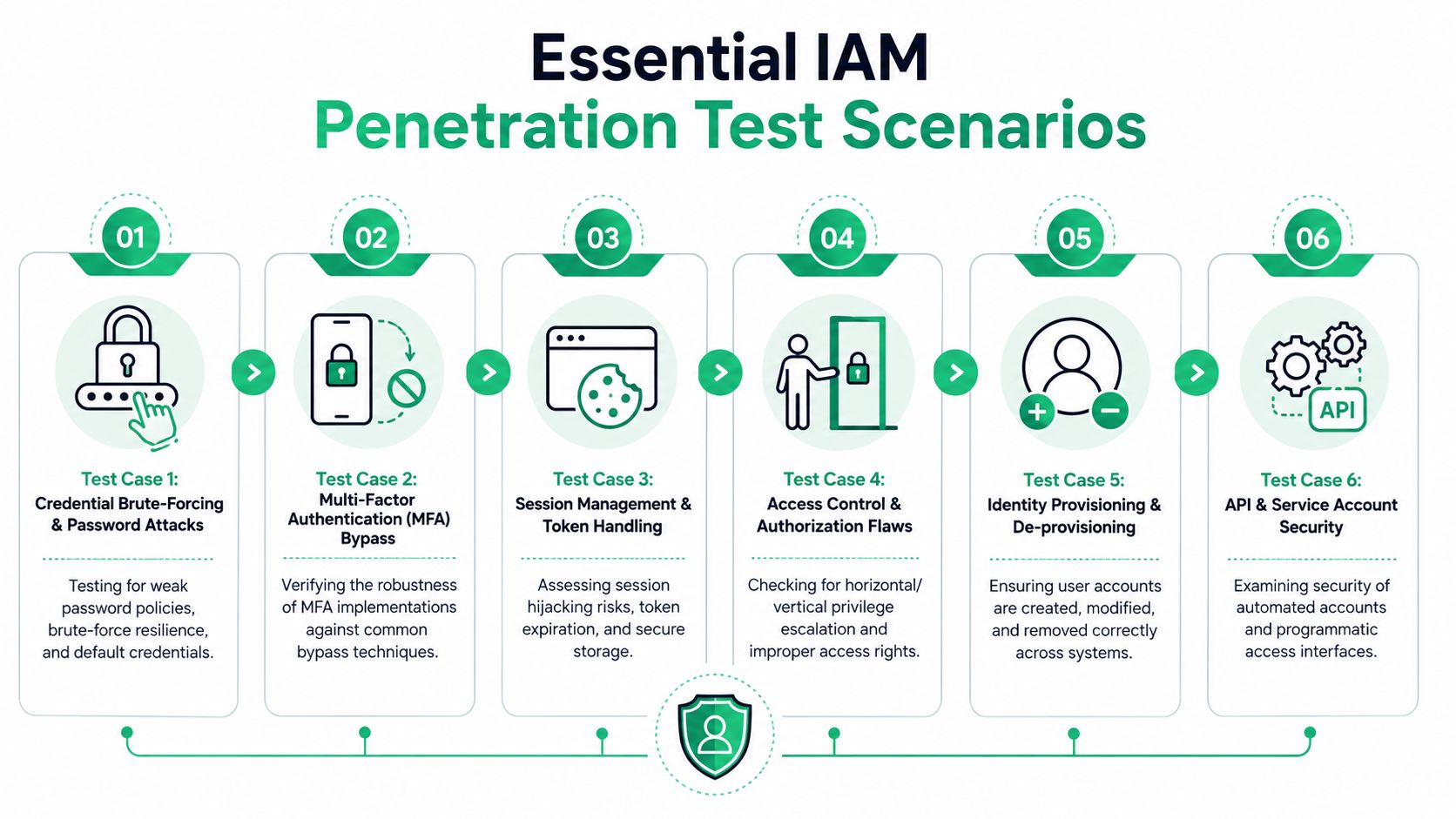
An effective IAM pentest proves its worth. You need test cases that map to how people log in, get access, lose access, and abuse mistakes.
Authentication and session checks
Start with the front door. Weak authentication controls still create easy wins for attackers.
Your penetration test should check:
- Password policy weaknesses such as simple or reused passwords getting through
- MFA bypass routes through fallback methods, recovery flows, or poorly protected trusted devices
- Session handling flaws like long-lived tokens, weak logout behavior, or bad token storage
- SSO trust issues where one weak app gives too much access across others
These aren't edge cases. They're common places where a good-looking IAM design falls apart in production.
Authorization and lifecycle failures
Next comes access control. In this phase, testers look for users seeing or doing things they shouldn't.
Ask blunt questions:
- Can a basic employee read another team's data?
- Can a manager act like an admin through role confusion?
- Can a terminated user still sign in somewhere?
- Can a contractor keep access longer than approved?
Critical pitfalls in IAM include shared IDs and orphaned accounts. Organizations with shared IDs or an orphaned account rate over 1% experience 3.2x higher account takeover incidents, based on Prelude Security's IAM metrics guidance.
If you want a simple baseline for fixing these problems, review these essential access control practices. They line up well with what testers usually find first.
Privileged and directory-focused testing
Directory services still matter. If your business relies on Active Directory or hybrid identity, include role inheritance, delegated admin rights, stale groups, and service account exposure in scope. This active directory tester guide is a useful reference if you're trying to understand what a focused directory review should include.
Use this as a minimum test set for identity and access management testing:
| Test area | What the tester should verify |
|---|---|
| Login security | MFA, password policy, account lockout, recovery flow abuse |
| Role controls | Horizontal and vertical privilege escalation |
| SSO behavior | Trust boundaries, token handling, app-to-app access spread |
| Joiner mover leaver | Correct provisioning and fast deprovisioning |
| Shared and stale accounts | No hidden admin access through shared IDs or forgotten users |
| Service accounts and APIs | Ownership, least privilege, and exposure risk |
Shared accounts save a few minutes today and create ugly incident response work later.
If your provider can't walk you through these test cases in plain language, you're not buying solid pen testing. You're buying noise.
Mapping Your Test Results to Compliance
Auditors don't just want to hear that you ran a penetration test. They want evidence that the testing supports the controls they care about.
That's why your report should tie IAM findings to real compliance requirements. If the report only lists technical issues without showing how they affect SOC 2, ISO 27001, PCI DSS, or HIPAA, your security team still has to do translation work later.
What auditors actually need
Auditors want proof that access is controlled, reviewed, and removed when it's no longer justified. They also care that authentication works reliably and quickly enough for the business to operate without people bypassing the process.
Key IAM metrics for proving Zero Trust maturity include an MFA success rate over 98%, an orphaned account rate below 1%, and over 90% of access requests processed within 24 hours, according to miniOrange's IAM metrics reference.
If your team is preparing evidence, a short internal checklist helps. This fast guide for audit readiness is useful for organizing what to hand over before the assessor starts asking for screenshots and policy exports.
IAM test to compliance mapping
Use a simple crosswalk so the findings speak the auditor's language.
| IAM Test Case | SOC 2 Control | ISO 27001 Control | PCI DSS Requirement | HIPAA Safeguard |
|---|---|---|---|---|
| MFA enforcement and bypass testing | CC6.1 | A.9 access control objectives | Requirement 8 | Access control |
| Privilege escalation and role abuse | CC6.1 | A.9 user access management | Requirement 7 | Access control |
| User provisioning and deprovisioning | CC6.2 | A.9.2.6 removal or adjustment of access rights | Requirement 7 and 8 | Workforce security |
| Shared account and orphaned account review | CC6.2 | A.9 account management | Requirement 8 | Information access management |
| Session and token handling checks | CC6 logical access controls | A.9 secure access practices | Requirement 8 | Person or entity authentication |
| Vendor access validation | CC6.1 and CC6.2 | A.15 supplier relationships and A.9 access control | Requirement 8 | Access authorization |
Add supporting context where needed
Some environments also use biometric checks at doors, devices, or restricted work areas. If physical and logical access overlap in your audit story, Wisenet Security's guide to biometric access gives a practical view of where that control can fit.
A clean compliance narrative is simple. We tested who can log in, what they can reach, how access is granted, and how access is removed.
That's what makes a penetration test useful for compliance. It turns access control from a policy claim into a verified control.
Choosing Your IAM Penetration Test Partner
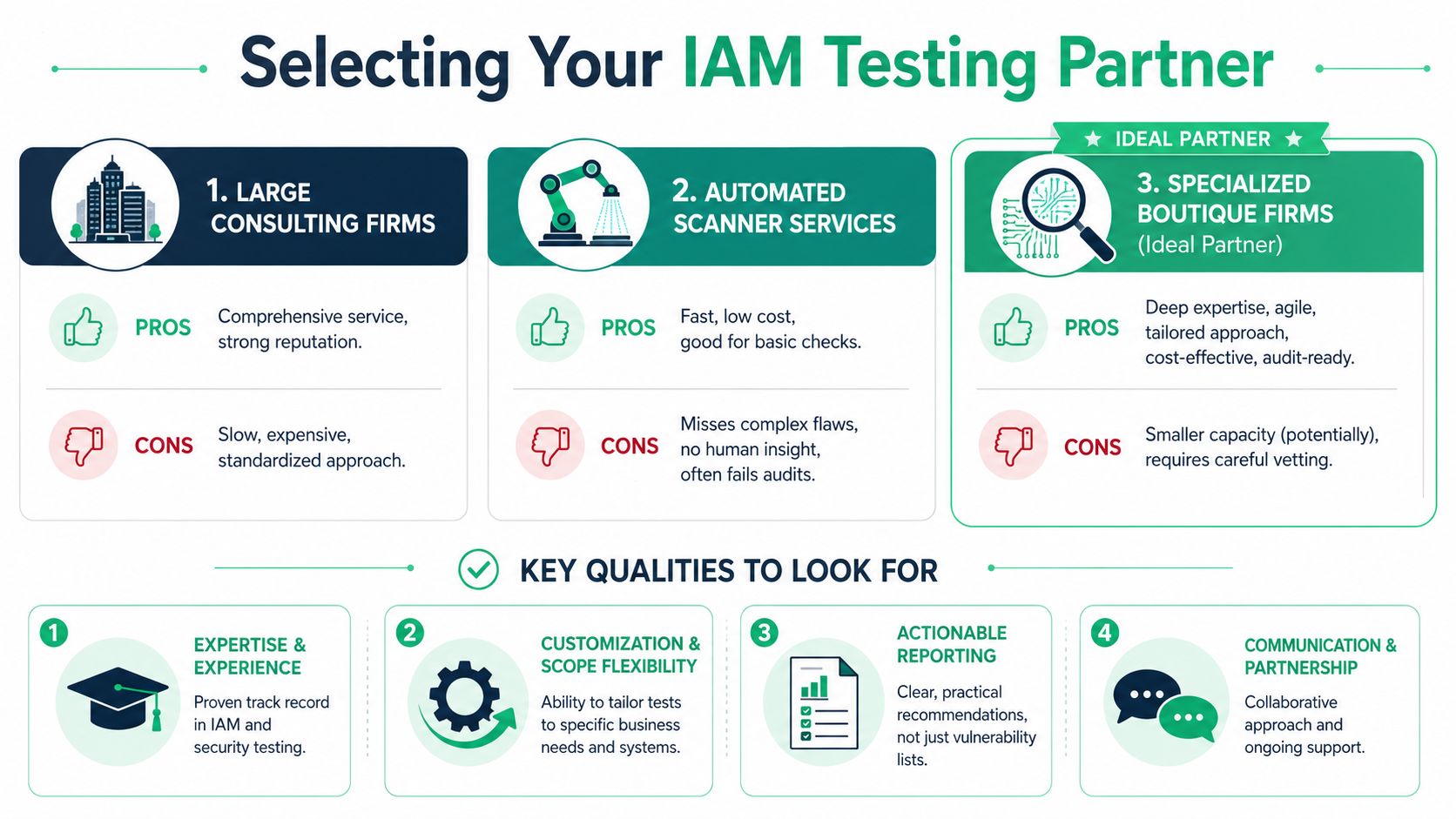
You have three basic choices. A large consulting firm, a scanner-heavy service, or a smaller specialist team that does manual penetration testing. Only one of those usually fits a startup budget and audit deadline.
Compare cost speed and depth
The average industry cost for a standard web application penetration test is $5,000 to $30,000, and standard manual pentests often land in a 3 to 6 week turnaround range, while affordable providers can start much lower and deliver reports within a week, based on Cyber GL's penetration testing cost overview.
That's the first filter. If you need a report fast, slow is expensive even before you look at the invoice.
Then look at how the work gets done. Certified ethical hackers with OSCP, CEH, and CREST credentials can use the same methodical process as bigger firms. Reconnaissance, scanning, enumeration, exploitation, and reporting. The difference isn't that enterprise firms own magic. It's that many of them carry more overhead.
What to demand from a provider
Don't shop on brand name alone. Shop on whether the partner can do the work your audit and security posture need.
Use these criteria:
- Manual depth over automated noise. A scanner can find easy issues. It won't think through broken approval logic or weird role inheritance.
- Certified testers with OSCP, CEH, or CREST, not a sales deck built around senior experts while junior staff do the test.
- Fast reporting so your team can remediate while the audit window is still open.
- Clear business writing in the report. You want fixes your IT manager can assign, not cryptic notes that need translation.
If you're comparing vendors, this short checklist can help you find your ideal pentesting vendor.
A cheap automated pen test can fail an audit because it lacks human validation. A huge consulting engagement can pass the audit but wreck your budget and timeline. The best option is usually a focused boutique provider that knows IAM, moves quickly, and writes reports people can act on.
Get Your IAM Security Audit-Ready Today
Identity and access management testing doesn't need to become a giant enterprise project. Most companies need a focused IAM pentest, a short remediation cycle, and a report that makes sense to both engineers and auditors.
The smart move is simple. Scope the systems that control access. Test the user flows that matter. Include vendors, admins, and service accounts. Get a manual penetration test done by certified pentesters who can deliver fast.
Keep your IAM program practical. Clean up stale accounts. Tighten role mapping. Make offboarding real, not assumed. If you also need to reduce software waste while tightening reviews, this guide on how to reduce Zendesk agent license waste is worth a look because access review and license cleanup often belong in the same conversation.
Security and compliance don't have to fight your budget. A fast, affordable pen test can give you the proof you need without months of waiting. If you're under audit pressure, stop overthinking it and use your contact form to get a quote.
Affordable Pentesting helps startups and growing teams get fast, audit-ready penetration testing without enterprise pricing or endless delays. If you need an IAM pen test, pen testing for compliance, or a broader penetration test delivered by certified testers, contact Affordable Pentesting through the contact form and get a quote.