.svg)
Let's cut the jargon. Imagine your business is a fortress. You need to know if your walls and guards can actually stop an attack.
The red team is a crew of ethical hackers you hire to find ways to break in. The blue team is your own security staff defending the fortress.
And purple teaming? That’s when both sides team up to fix security gaps on the fly, combining offense and defense to make you stronger, faster.
What Are Red, Blue, and Purple Teams?
Understanding these teams is key to building a strong security program without the huge price tag. For CISOs and startup founders, knowing which approach to use is the fastest way to protect your assets and pass compliance audits like SOC 2 or HIPAA. It all comes down to a clear, affordable strategy.
Think of it simply: red team is offense, and blue team is defense.
Red Team (Offense): This is a team of certified ethical hackers, usually from a firm like ours, hired to simulate a real-world attack. Their job is to think like a hacker and punch holes in your systems. Our red team pentesters hold certifications like OSCP and CEH, using their skills to find vulnerabilities before a real attacker does.
Blue Team (Defense): This is your in-house IT and security crew. They monitor systems for suspicious activity, respond to alerts, and keep your defenses like firewalls up and running. They are the 24/7 guardians of your digital fortress.
This is how these teams fit into a modern security organization.
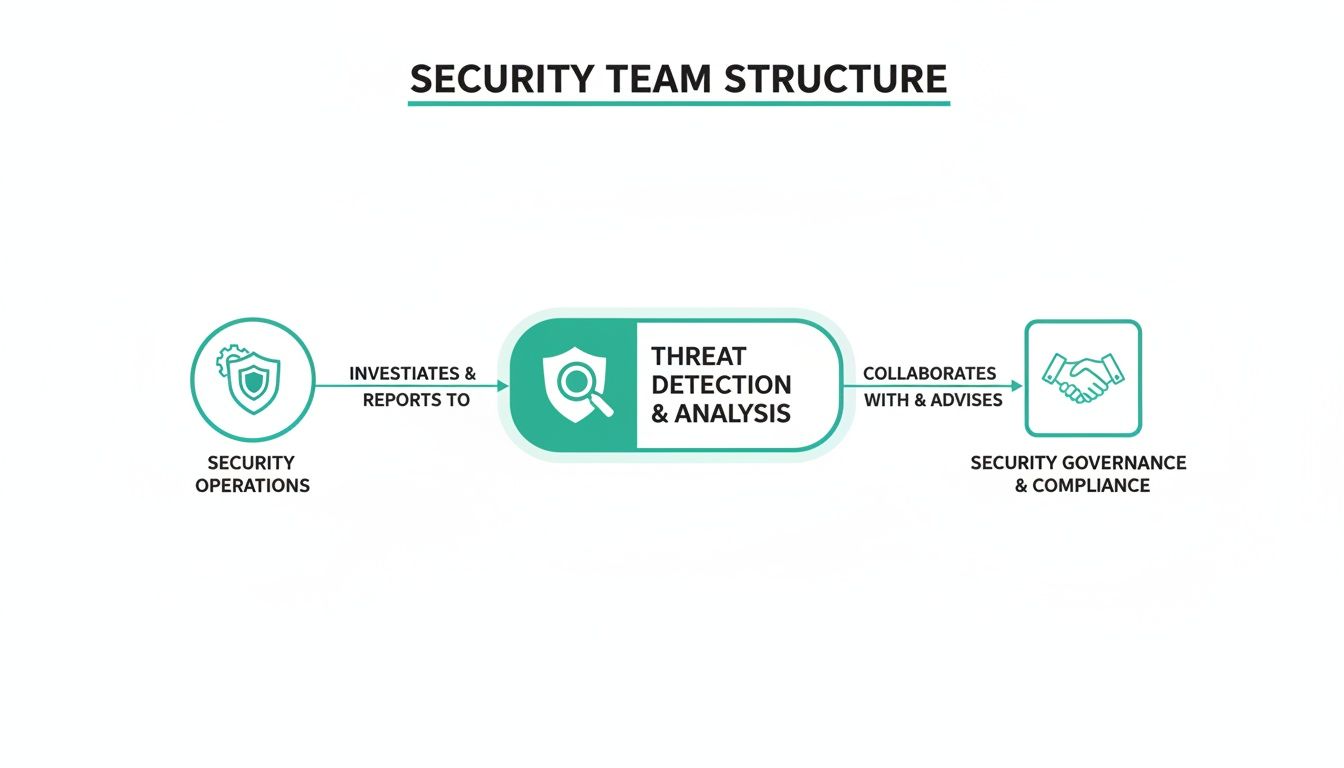
The chart shows the classic separation. But the real magic happens when you tear down the walls between them. A purple team is not a separate group of people. It is a process where your red and blue teams stop working in isolation and start talking.
Instead of a surprise attack, a purple team exercise is a collaborative event. The red team announces its attack techniques, and the blue team works to detect and block them in real-time. This creates an immediate feedback loop, turning a standard penetration test into a high-value training session.
Uncover Hidden Flaws With Red Teaming
A red team engagement is like a fire drill for your security. You hire certified, ethical hackers to break into your systems just like a real attacker would. Their job is to find the security holes in your defenses before the bad guys do.
For a startup or small business, this is the fastest way to get an honest report card on your security. A red team exercise tells you exactly where you stand. Our pentesters, with certifications like OSCP, CEH, and CREST, go far beyond automated scans to find the complex gaps that scanners always miss.
If you handle sensitive data, a red team engagement is a business necessity. Auditors for compliance frameworks want proof that your security controls are effective, and a third-party penetration test is their gold standard. This is non-negotiable for SOC 2, PCI DSS, and HIPAA.
A red team report delivers the hard evidence you need to satisfy auditors. It turns your security program from a list of policies into a battle-tested reality. This type of manual pen test is designed to find flaws that automated tools are simply blind to.
A common complaint about traditional security firms is their slow, expensive process and vague reports. Our focus is on providing an affordable pentest that gives you clear, actionable results, fast. We deliver this report within a week of the engagement, so your team can get to work immediately.
By simulating attacks, you are not just testing technology; you are testing your people and processes. A good red team pen test shows you how an attacker could move through your network and access your data. To dig deeper, you can explore our guide on what red team testing involves.
Understand The Role Of Your Blue Team
Your blue team is your first line of defense. Think of them as the security team on the ground, your system admins and security engineers working to protect your digital turf. Their job is to build a fortress, watch the walls, and jump into action when an alarm sounds.
These are your internal security pros. They are responsible for everything from configuring firewalls and managing access to sifting through alerts. A blue team's goal is to maintain a tough defense, which means implementing solid network security best practices.
A blue team's work is never done. They are the backbone of your day-to-day security, focused on protecting your systems from the inside out. Their work includes monitoring systems, responding to incidents, and constantly tuning security tools.
While a great blue team is essential, a purely defensive mindset has limits. Your defenders become experts at using their own tools, but they have no way of knowing what they cannot see. This is where the value of an external, manual penetration test becomes obvious.
A good pentest from certified experts mimics the creative tactics of a real attacker. It shines a light on the gaps your blue team can’t see. For a closer look at the operational side, check out our guide on what a Security Operations Center is.
Our affordable pentest services solve this exact problem. We give your blue team a realistic sparring partner. Our OSCP and CREST certified pentesters act as a controlled adversary, giving your defenders priceless, hands-on experience detecting and responding to a simulated attack.
We deliver a clear report within a week, showing you exactly how our red team got past your defenses. This turns a simple pen test into a massive learning opportunity. It helps your blue team tune their tools and sharpen their incident response plans.
Maximize Your Security ROI With Purple Teaming
You know red teaming finds security flaws and blue teaming builds defenses. But what if you could combine them and get more than double the value? That’s what a purple team exercise does, turning a standard pentest into a live-fire training session for your defenders.
Purple teaming is not a separate team you hire. It is a collaborative sport where the attackers (red team) and defenders (blue team) communicate in real time. The red team announces, "We're about to try this," and your blue team works to detect and block it on the spot.
For IT managers and CISOs, the purple team approach delivers the best return on your security budget. You are not just getting a report listing vulnerabilities; you are actively leveling up your internal team’s ability to defend the company. That immediate feedback loop is what makes it so powerful.
When our OSCP-certified red team runs an attack, your blue team sees instantly if their tools caught it. If not, they can fine-tune detection rules right then and re-test, closing a gap in minutes, not months. This turns a compliance pen test into a hands-on workshop that delivers real skills and improves security, as seen with this collaborative approach drives security improvements on cymulate.com.
The value of purple teaming is crystal clear. It’s the most efficient way to mature your security operations, especially if you're tired of slow, expensive penetration testing firms. It improves detection, builds a stronger security culture, and helps you fix vulnerabilities faster.
A purple team engagement stops being about "passing a test" and starts being about genuine skill-building. Our approach makes this high-value exercise affordable. We bring offensive expertise with our CREST and CEH certified pentesters and guide your blue team through the improvements.
You get all the benefits of a top-tier training program wrapped in the fast, affordable pentest you need. For a deeper dive, check out our guide on how to run a successful purple teaming exercise. This ensures you get the maximum security ROI, fast.
Choose The Right Security Test For You
So, red team, blue team, or purple team? The right choice comes down to one question: "What is my biggest security problem right now?" Do not let a traditional security firm sell you an expensive engagement you do not need.
Your security needs are not static; they change as you grow. A startup launching a product needs something different than an established company facing an audit. Understanding this is key to investing your security budget wisely.
For a startup launching a new product: A fast, affordable red team penetration test is your best first move. You need a clear report on what to fix, delivered in about a week.
For compliance like SOC 2, HIPAA, or PCI: A formal red team engagement is non-negotiable. Auditors demand third-party validation that your security controls work. Our OSCP-certified pentesters deliver the manual testing and report you need.
If you have an internal security team: A purple team exercise offers the highest ROI. This approach turns a standard pentest into a live-fire training session for your team, dramatically improving their skills.
For businesses with an internal team, purple teaming is about building a stronger security culture. Integrating security into every stage of development, like with cloud security best practices for DevOps teams, is a perfect example of this collaborative mindset in action.
Choosing between these engagements is about being honest about your current goals. The objective is to get the most value for your money. Whether it’s a quick pen test to secure a product or a collaborative exercise to train your team, we provide expert guidance and fast reporting without the hassle.
Get An Affordable Pentest Report In A Week
Let's be honest, traditional penetration testing is broken. You get quoted a huge price, wait weeks, and end up with a confusing report that finds little of value. As an IT manager, CISO, or founder, you need a pen test that helps you get secure, not one that just burns your budget.
We started this company to fix that broken model. Our approach is simple: we deliver affordable, manual pentests from certified experts and get you a report within one week. This is the practical, no-nonsense solution you've been looking for.
Stop overpaying a big-name firm that takes months to deliver. Whether you're a startup securing your first app or an SMB chasing a compliance deadline, our model was designed for you. We know your challenges because we built our process to solve them.
- Need a pen test for SOC 2 on a tight deadline? We’ve got you. Our speed ensures you hit your audit dates without the stress.
- Tired of reports with zero real findings? Our OSCP, CEH, and CREST certified pentesters think like actual hackers. They find critical flaws that automated scanners always miss.
- Worried about the cost? Our pricing makes high-quality manual penetration testing accessible, proving you don’t need an enterprise budget for strong security.
Our focus on affordability and speed makes it easier to adopt practices like red teaming, blue teaming, and purple teaming. A 2022 IANS Research analysis found that collaborative exercises can cut threat detection times by 40-60%. To see how these teams work together, read the full research on the roles of security teams.
Choosing the right security partner should not be a headache. We skip the buzzwords and the long sales cycles. Our process is built on speed, expertise, and affordability, giving you exactly what you need to protect your business.
Ready to see how a manual penetration test should be done? No more waiting games, confusing reports, or shocking invoices. If you are ready for a better penetration testing experience, just fill out our contact form.
Frequently Asked Questions About Security Testing
We get it. Security testing is confusing, and the jargon makes it hard to know what you need. Here are direct answers to the questions we hear most from IT managers, CISOs, and startup founders.
How often should we conduct a penetration test?
For most businesses, an annual penetration test is the absolute minimum. This is a hard requirement if you need to comply with regulations like PCI DSS or SOC 2. You also need a fresh pentest after any major change. Our model makes it affordable to test more often, so you're not guessing about your security between audits.
Is a red team engagement different than a scan?
Yes, and this is a critical distinction. An automated vulnerability scan is like rattling doorknobs to see if any are unlocked. It’s noisy, basic, and only finds obvious issues. A red team engagement, or a manual penetration test, is when one of our OSCP or CREST certified experts picks the lock and finds a clever way into the building. Our manual pentests find critical flaws that automated scanners will always miss.
We are a small business. Can we afford this?
Absolutely. We built our services for the startups and SMBs priced out by traditional pentesting firms. A single breach can wipe out a small company, which is why we make proactive, expert-driven defense accessible.
What certifications do your pentesters hold?
Our strength is our team. They hold the industry’s most respected certifications, proving they can think like the adversaries you’re worried about. This includes Offensive Security Certified Professional (OSCP), Certified Ethical Hacker (CEH), and CREST Registered Penetration Tester. This means your systems are tested by pros who use the same techniques as real-world attackers.
Ready for a better, faster, and more affordable penetration testing experience? Affordable Pentesting gets you a comprehensive, manual pentest report from certified experts in about a week. Get the clarity and security you need by reaching out to us via our contact form.